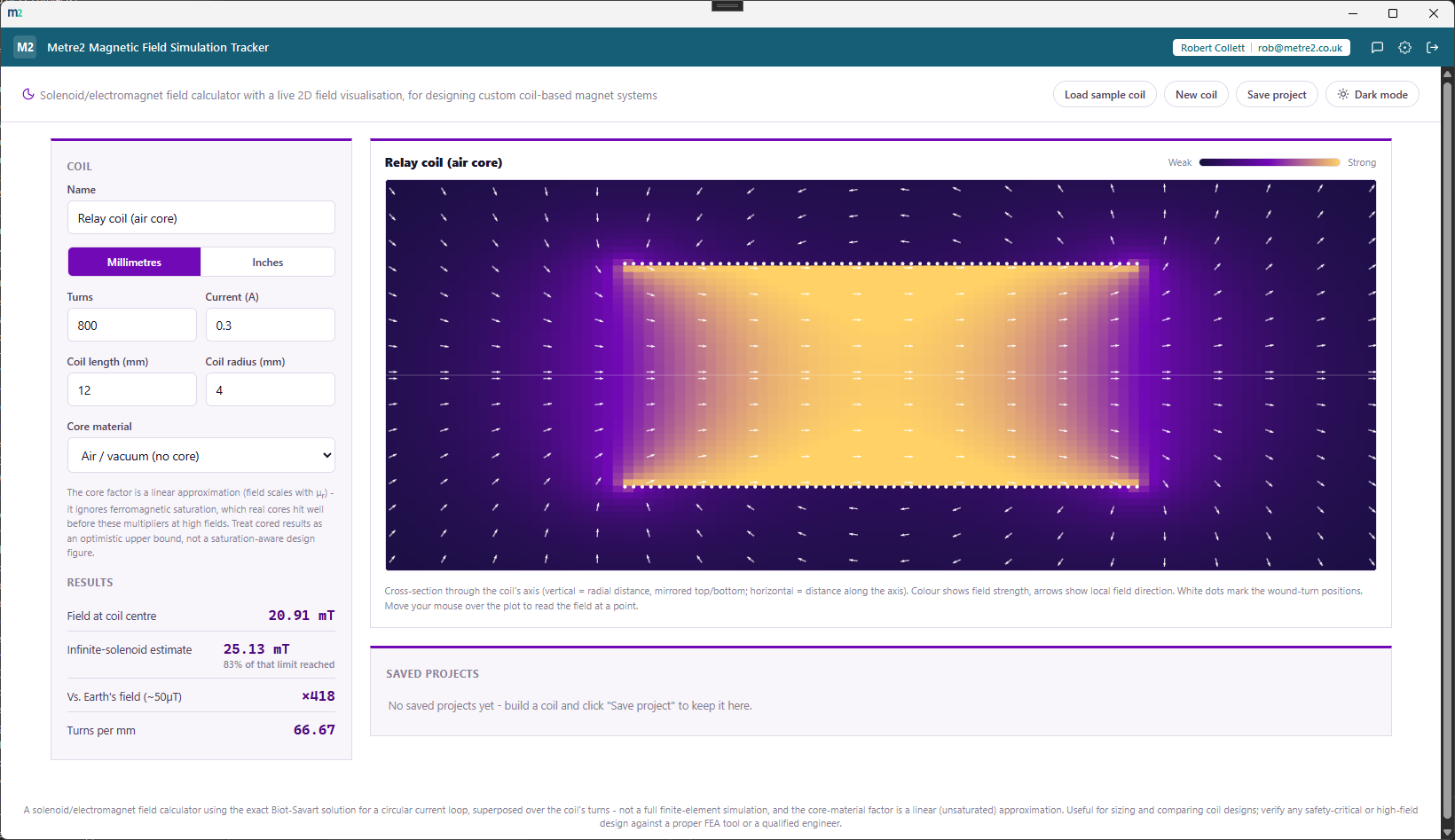
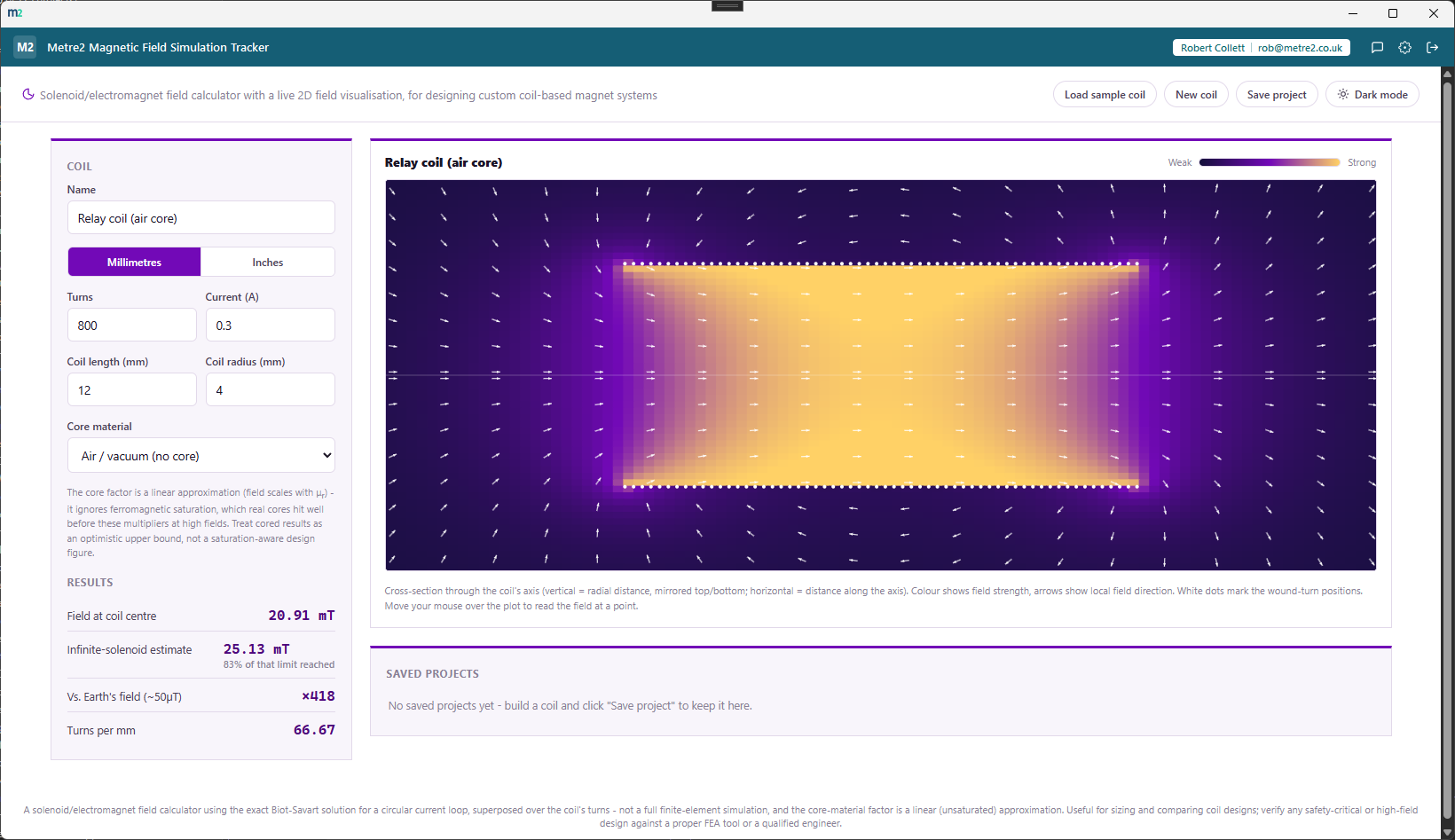
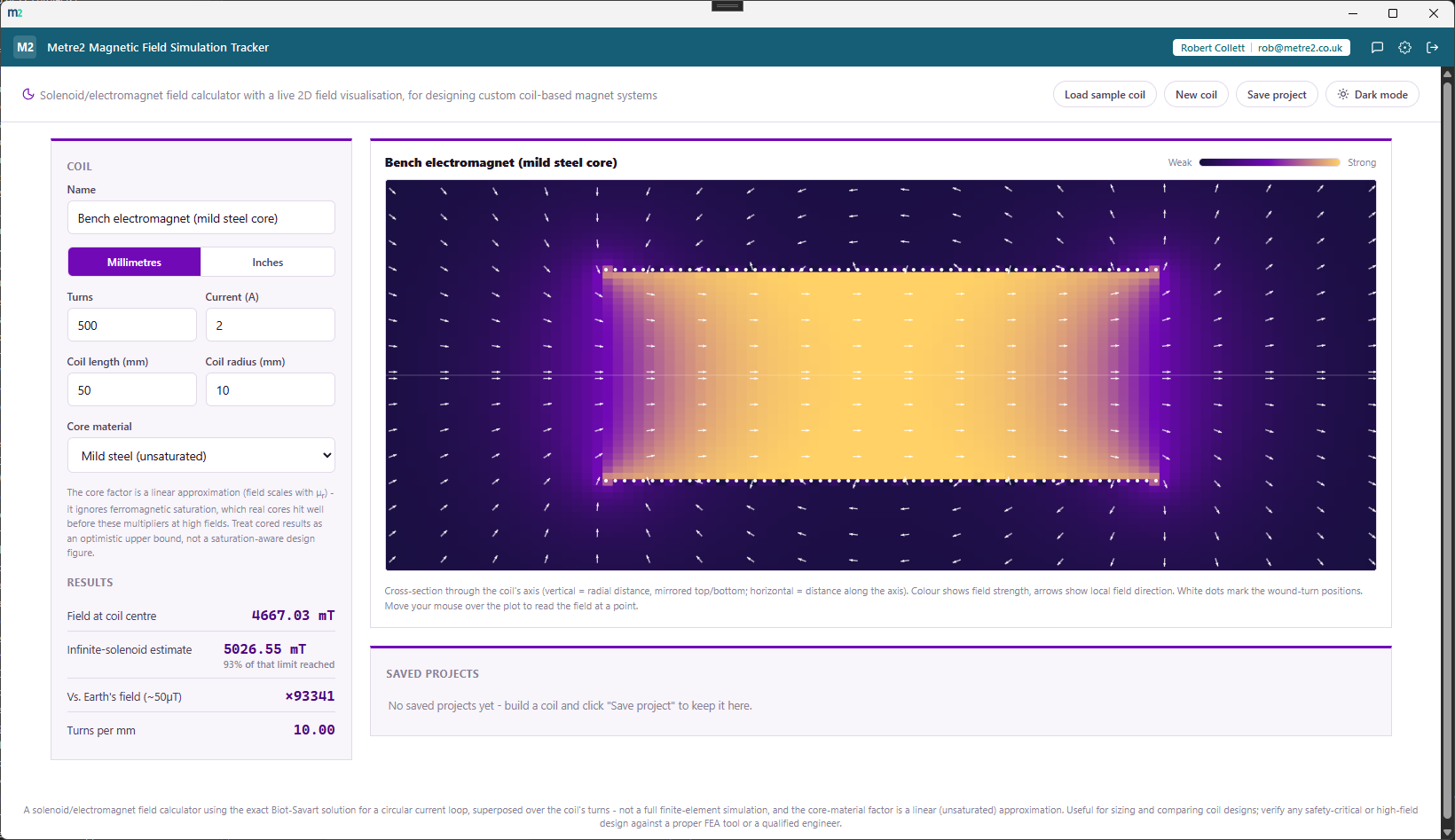
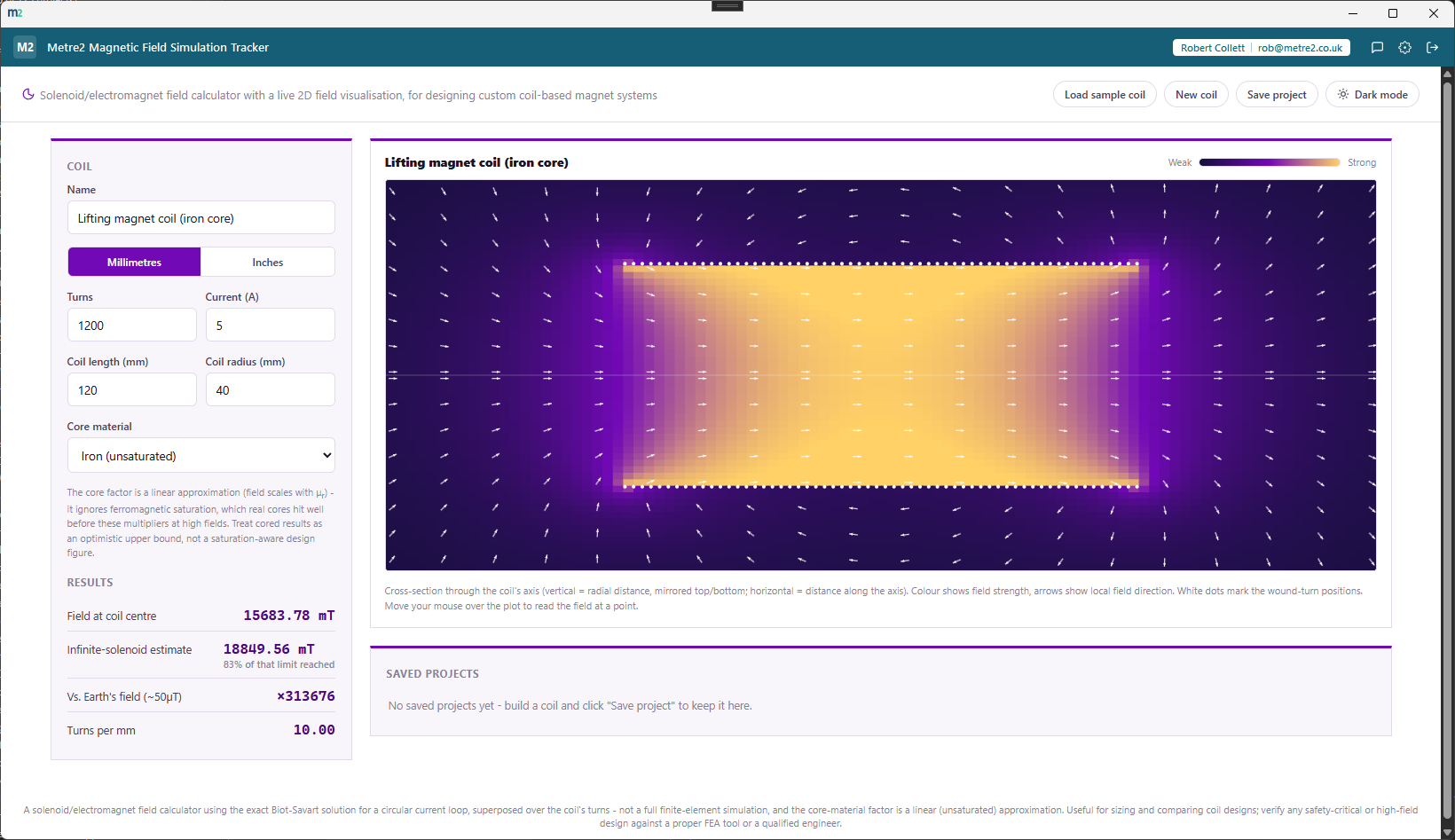
Exact Biot-Savart solution, not an approximation
The core solver uses the closed-form elliptic-integral solution for a circular
current loop, superposed across the coil's turns - the same physics behind textbook
solenoid formulas, verified against them and against an independent numerical
line-integral in the app's own test suite.
Live 2D field visualisation
A colour-mapped flux-density heatmap with quiver arrows showing field direction and
strength around the coil, plus a hover readout that reports the exact field at any
point on the canvas.
Turns, current, geometry and core material
Set turns, current, coil radius and length, then compare air, mild steel, iron or
ferrite cores (or enter a custom relative permeability) to see how much a core boosts
the field - modelled as a linear, unsaturated upper bound.
Results in the units you think in
Centre field in tesla, millitesla and gauss, percentage reached versus the
infinite-solenoid approximation, and a multiple of Earth's field for a quick sense of
scale.
Save and compare coil designs
Save named coil configurations as you iterate, then load, duplicate or delete them
to compare turns/current/geometry trade-offs side by side.
Built for a real window, light or dark
A workbench layout that spreads the config rail and the field canvas across a wide
window, with a light/dark toggle that remembers your choice.